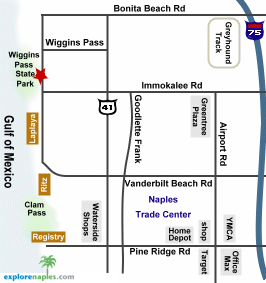
map is not to scale

|
One of the most popular seaside destinations in Naples, the mile-long stretch of white sugar sand at Delnor-Wiggins has been rated one of the best beaches in the nation. The 199-acre park is a tropical paradise for beach lovers, boaters and divers. The beach is a popular spot to sunbathe, swim, beachcomb, snorkel and picnic. At the beach along Wiggins Pass, where swimming is not allowed, fishing is a popular activity. Boaters can launch their vessels into Water Turkey Bay and travel to the Gulf or up the Cocohatchee River for both saltwater and freshwater fishing. Kayakers can enjoy paddling through estuaries and scuba divers can explore the hard bottom reef in the Gulf. At the north end of the island, a tower gives visitors a bird's-eye view of Wiggins Pass and the surrounding coastal habitat.
Overview of Delnor-Wiggins Pass State Park
Separated by the mainland by mangrove swamps and tidal creeks, this recreation area is located on a narrow barrier island off Florida's southwest coast. A pass on the north end of the island is a natural outlet for the Cocohatchee River. The park offers Gulf-front swimming, fishing, picnicking and a boat ramp in a lush setting of sea oats, sea grapes, cabbage palms and mangroves. Delnor-Wiggins Pass State Park is located in North Naples six miles west of I-75, exit 111.
Delnor-Wiggins Pass State Park one of the most popular Naples Florida Beaches in Southwest Florida. Occupying the north end of a barrier island, the pass serves as a natural outlet for the Cocohatchee River. The variety of vegetation at Delnor-Wiggins Pass creates a lush wildlife habitat, featuring sea oats, sea grapes and cabbage palms. The main feature in the park, however, is the mangrove forest. Occupying 80 percent of the park, the leaves of the mangroves provide a major source of nutrition for the marine animals that begin their life in the backwater before entering the Gulf.
Mangroves also buffer the mainland against destructive storms, prevent erosion with their specialized root system and filter the water to maintain quality and clarity. The natural coastal area of Delnor-Wiggins provides habitat for a wide variety of wildlife. The most visible are the many species of shore and wading birds, small mammals and reptiles. The shallow Gulf waters are home for countless forms of marine life such as soft corals, mollusks, crustaceans and fish. Endangered loggerhead sea turtles come ashore on summer nights to lay their eggs. In the winter, the pass if often frequented by the endangered West Indian manatee seeking warm water.
In the 1600's, the Calusa Indians thrived around the pass by gathering wild plants, fishing and hunting. During the 1800's the Seminole Indians and early European settlers found refuge in this semi-tropical area. Joe Wiggins, for whom the pass is named, operated a small trading post and is the first homesteader on record.
Several generations later, through the foresight of Lester J. and Dellora A. Norris, the land was acquired as a park for Collier County in 1964. Six years later, the Division of Recreation and Parks purchased the land from the county for development of a state park. After completion of the development, Delnor-Wiggins Pass State Recreation Area was officially opened to the public in 1981. Years later the Division of Recreation and Parks renamed the recreation areas to state parks.
Delnor-Wiggins Pass State Park - Activities
A variety of recreational activities are offered at Delnor-Wiggins Pass State Park. For convenient access to the beach, five parking lots with a system of connecting trails and boardwalks are available. Picnic tables, grills and bicycle racks are provided as well as bathhouses with changing stalls and out-door showers. A picnic pavilion, observation tower and boardwalk access to Wiggins Pass can be found at the very north end of the park.
A boat ramp allows access to the back bays, Cocohatchee River and the Gulf of Mexico, providing visitors with excellent fishing opportunities. The most popular place to fish is Wiggins Pass. It is also the only area along the park's beach where fishing is allowed. Visitors who plan to fish should remember to dispose of monofilament fishing line properly as it can injure or kill animals in the park.
Swimming and shelling are popular pastimes year-round. Because of dangerous currents and deep water, swimming is never allowed in the pass. In order to conserve shell resources for future generation, collecting of live shells, including starfish and sand dollars, is prohibited. For more information contact Delnor-Wiggins Pass State Park at 239.597.6196.
Listing of Activities
Beaches
A pristine beach on the Gulf of Mexico, Delnor-Wiggins Pass State Park has some of the best shelling opportunities on the Gulf coast. Live shelling is prohibited. Two beach wheel chairs, one in area 1 and one in area 5 are available and free for use to the public.
Boat Ramp
The boat ramp empties you into Water Turkey Bay, which runs via the South Channel into the Cocohatchee River. The docks at the boat ramp are ADA accessible.
Boating
From the Cocohatchee River you can go north via the back bays up into Estero Bay, east up the Cocohatchee River or, as most visitors do, head west into the Gulf of Mexico through Wiggins Pass.
Fishing
Fishing covers a wide area around the park. You can fish from a vessel in the Gulf, Water Turkey Bay and the Cocohatchee River, except within 300 feet of the park beach along the Gulf of Mexico. This area is buoyed off for swimming. No vessels are permitted to anchor within 100 feet of the designated fishing area, which encompasses the pass. You may fish from the shoreline along Wiggins Pass or wade fish in Water Turkey Bay. Fishing is prohibited in the swimming areas of the park.
Interpretive Exhibit
An interpretive exhibit is located at the picnic pavilion. There is also a kiosk on shore birds on the beach near Wiggins Pass.
Pets
Pets are allowed in this park, however, not on the beaches. They must be well-behaved and kept on a six-foot, hand-held leash at all times. Pets must not be left unattended, or taken into restroom facilities or concession areas. You must "scoop" after your pet. (Don't forget your baggies!) These rules help preserve an important habitat for wildlife. Please do not leave your pets unattended in a vehicle for their safety, as temperatures inside vehicles can be dangerously high. Service animals are welcome in all areas and buildings of the park, as required by law.
Picnic Pavilion
The covered, open-air pavilion is located at the north end of parking area 5 in the Coastal Hammock. There is also a grill nearby for your convenience. The pavilion accommodates up to 100 people and has 10 picnic tables. To reserve the picnic pavilion, call the park at 239.597.6196.
Picnicking
We have picnic areas located between each parking lot and the beach with boardwalks leading to them. They are located in a Coastal Hammock for shade. There are grills and tables available.
Restroom Facilities
Delnor-Wiggins Pass State Park has six (6) restroom facilities. All are ADA accessible.
Scuba Diving
There is a hard bottom reef, which runs parallel to the beach where scuba diving is permitted. The closest area to the reef is area 2.
Showers, Day Visitors
Fresh water rinse showers are available at the park.
Snorkeling
Snorkeling is permitted along the beach. There is a hard bottom reef, which runs parallel to the beach where scuba diving and snorkeling is permitted. The closest area to the reef is area 2.
Swimming
Swimming is permitted from the southern boundary up to the middle of Parking Lot Five, a distance of almost one mile. No swimming is permitted in Wiggins Pass due to the dangerous currents there.
Programs
Rangers programs are offered every Thursday at 9:30am. Most programs are free with park entry fee. Please call the Ranger Station for more information or for a full program listing check out our website.
Wildlife Viewing
Resident eagles, ospreys, owls, and other woodland species make room every fall for the migratory shore birds. Bring your binoculars and cameras, there will be plenty of opportunities to use both.
Information courtesy Florida Division of Recreation and Parks |

 Pictures
  What to do
  Where to stay
  Real Estate
  Tourists
  Residents
  Tell a friend
  Home
Home